Monday morning, a marketing manager discovers your AI meeting assistant in a Slack community. She runs it on three meetings, saves two hours of note-taking, loves it. On Thursday she messages her boss: "We should get the paid plan, it's really good." The reply: "Sure, send me the details." Then nothing. No refusal, no objection. Just silence.
Your tool didn't lose to a competitor. It lost to an internal approval that never happened, because your user had nothing to forward. And you will never know: in your analytics, that company still shows up as an "active free user." Plenty of signups, happy users, but disappointing paid conversions inside companies? The cause is almost always the same: your marketing speaks to one person, while the purchase involves two.
Two players, one purchase
You don't need a persona factory with fictional first names and stock photos. Two simple profiles are enough to start, as long as you keep them clearly apart.
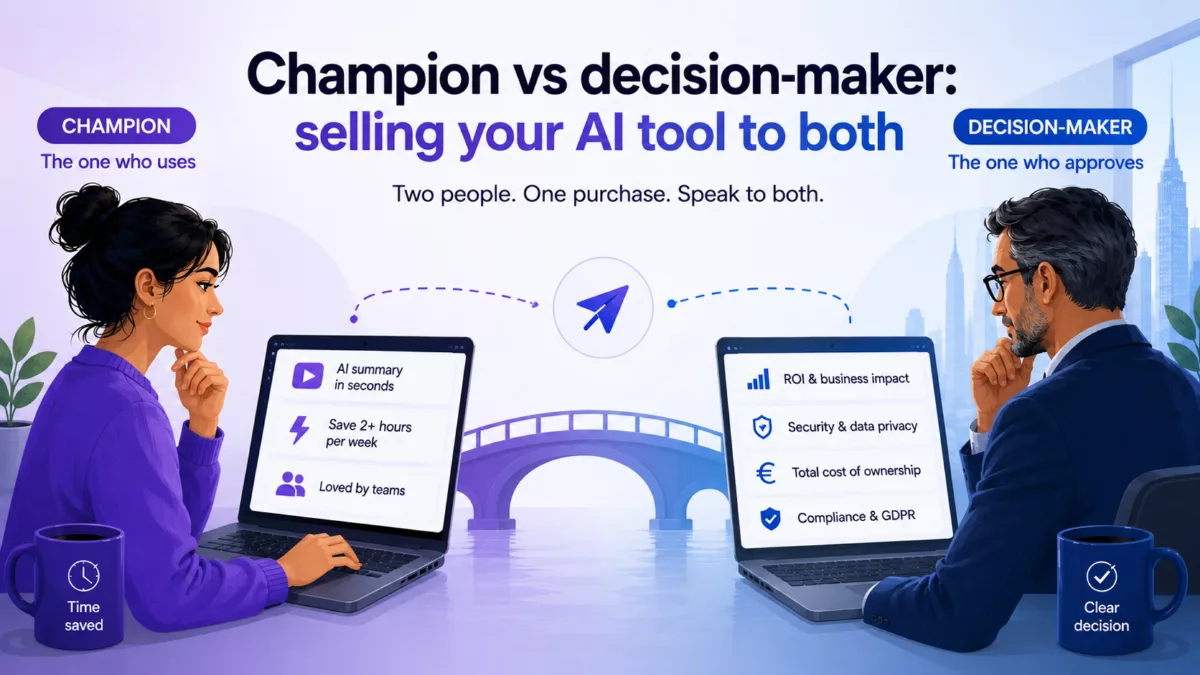
The champion: the one who uses
The champion is your day-to-day user. They find your tool on their own: a community, a directory, a YouTube video, a colleague. They test the free tier on real work and adopt the tool if it delivers. What they're buying isn't your technology: it's time saved and simplicity. An image generator that produces decent visuals in three clicks, a support agent that clears 60 tickets while they're at lunch.
In the AI tools market, adoption is overwhelmingly bottom-up: the user almost always arrives before the decision-maker. Your champion is the one who brings your tool into the company, not your sales team.
The decision-maker: the one who approves
The decision-maker is the person who authorizes the spend. Who that is depends on company size: for a freelancer, it's the champion themselves, more on that below. In a small team, it's the direct manager, one conversation and a budget line will do. In a larger organization, it's a chain: leadership, procurement, sometimes IT and legal, each with their own questions.
What the decision-maker buys isn't time saved: it's reliability. A defensible ROI, security and compliance guarantees, a clean way out of the tool if needed, invoicing that accounting will accept. They have probably never used your product: they judge only what they're shown.
What each of them expects from you
Same tool, two radically different readings. In short:
| Champion | Decision-maker | |
|---|---|---|
| What they buy | Time saved, simplicity, a smoother workday | Reliability: ROI, security, compliance, reversibility |
| Their typical questions | "Will it work on my use case? How long until I'm up and running?" | "What does it cost per year? Where does our data go? What happens if we stop?" |
| Content that reassures them | Video demo, free trial with no credit card required, tutorials, concrete examples | Case studies with numbers, security and GDPR page, clear pricing grid, invoicing terms |
| Where to reach them | Communities, specialized directories, YouTube, word of mouth | LinkedIn, the champion's internal recommendation, the file forwarded for approval |
The right-hand column is the one most AI tool makers leave empty. That's where sales die in silence.
The four classic mistakes
First mistake: a website that only speaks to the champion. Spectacular demo, playful tone, promise of instant results, and nothing for the person who has to sign. When our marketing manager's boss opens your site, they're looking for decision-maker answers and find only a user's pitch.
Second mistake: opaque pricing. "Contact us" on the business plan, credits nobody can map to actual usage, no annual price displayed. A decision-maker won't approve a spend they can't project over twelve months.
Third mistake: no proof. No case studies, no numbers, no customer references. The champion believes you because they tested. The decision-maker only has your website to form an opinion, and a site without proof reads like a promise without a guarantee.
Fourth mistake, the most common one: giving the champion nothing to sell with internally. You leave them alone in front of their boss, armed with nothing but "it's really good." They're not in sales, they don't know how to build an approval case: they try once, politely, then move on.
Marketing to both
The good news: this isn't a rebuild, it's a completion of what you already have.
Champion side: be findable and testable
Champions discover you where they already look: the communities where your audience spends time, YouTube with demos on real use cases, and the AI tool directories where users compare before they try, the role AI Shortlist plays for its readers. Then offer a free trial generous enough for the tool to prove itself on real work. A half-convinced champion won't champion anything at all.
Decision-maker side: answer before they ask
The decision-maker won't discover you: someone will hand them your name. Your job is to prepare the ground. A security and compliance page that answers GDPR and SOC 2 questions without a sales call: where the data is hosted, who can access it, how to export or delete it. Case studies with real numbers, even modest ones, beat a grand unverifiable promise. Transparent pricing with an annual rate, quote-based invoicing and payment by bank transfer, because a personal credit card waiting for reimbursement is one more point of friction. And a serious LinkedIn presence, because it's often the only place a decision-maker will go to check who you are.
Arm your champion: they're your best salesperson
The idea that changes the most, and that very few AI tool makers act on: your champion is already selling you internally. The only question is whether they're doing it empty-handed.
Give them ammunition. A ready-made "convince my boss" email they can adapt in two minutes: what the tool does, what it has already delivered for them, what the subscription costs, what needs to be decided. An ROI recap generated from their own account: estimated time saved, volume handled, before and after. A "for your leadership" page designed to be forwarded as-is, condensing security, pricing and references onto a single screen.
This arsenal costs a few days of work and turns every enthusiastic user into an equipped sales ally. Between a champion who says "it's really good" and a champion who forwards a complete case, internal approval rates are worlds apart.
When the two roles merge
In the AI tools market, this case is common, not marginal: freelancers, independents and founders wear both hats. The funnel shortens instantly: the person testing is the person paying, and the credit card can come out in ten minutes.
What changes is the weight of each lever. No internal sales kit needed: pricing and reassurance do all the work. A price readable at a glance, a plan you can cancel, a clear refund policy, and the decision follows straight from the trial. Conversely, the slightest friction, a hidden price or a mandatory signup before the demo, kills a sale that was within reach. If your tool targets independents first, focus your effort there.
Checklist: does your marketing speak to both?
Before you publish your next page or campaign, run through these eight points.
Does my site answer the decision-maker's three questions: annual cost, data security, reversibility?
Can someone who will never use the tool understand my pricing in thirty seconds?
Do I have at least one case study with real, verifiable numbers?
Does my security and GDPR page exist, and is it accessible without a sales call?
Can my user defend me in a meeting with a document I gave them?
Do I offer a "convince my boss" email or an ROI recap for internal approval?
Is my business invoicing (quotes, bank transfer, legal details) ready to go?
Am I visible where my champions look: communities, directories, YouTube?
Fewer than half the boxes checked? Now you know where your silent sales are going. Start with the email template and the decision-maker page: two one-week projects, not two redesigns.