"Our tool is for everyone." If that sentence appears anywhere in your pitch, you're probably looking at the cause of your disappointing conversions. A tool that speaks to everyone convinces no one: same words, same channels, same homepage for a freelance consultant, a support team and a marketing director, when none of the three buys for the same reasons.
The textbook answer to this problem is the persona, and it drags around a bad reputation it has earned: HR-style posters with a fictional first name, an age, hobbies and an inspirational quote, day-long workshops, fifteen-field templates nobody ever opens again. This guide proposes the opposite: a 5-step method you can run in a few days, ending in a one-page profile and immediate decisions.
A persona is for deciding, not decorating
Let's state the stance upfront: a persona is a decision tool, not a creative exercise. Done right, it settles at least three concrete questions. Where to invest your marketing time, instead of sprinkling effort across every channel at once. What message to put on your homepage, in your user's words rather than yours. And what to build next, because the roadmap of a tool aimed at "everyone" always ends up aimed at nothing in particular.
The test is simple and applies to every field in your profile: if a piece of information changes no decision, it's dead weight. The fictional first name changes nothing. The age, rarely. The hobbies, never. Knowing that your typical user discovers tools in Slack communities and needs sign-off for any spend above $50 a month, on the other hand, immediately changes your channels and your pricing.
Step 1: start from real users
A persona isn't invented in a meeting room, it's observed. The starting question: who has the most painful problem among the people touching your tool?
Look at your usage data through three successive filters: who signs up, who is still there after two weeks, who recommends or shares. The three groups don't always look alike, and the third one is the one you want: people who stay and recommend have a problem painful enough for your solution to become a habit. For an AI meeting assistant, you often discover the core users aren't "people who have meetings" but, say, project managers who run back-to-back client meetings and have to produce meeting notes with commitments in them.
No users yet? Look for who has already paid for an alternative: a competitor, a freelancer, a duct-taped process that eats time. Someone already paying to solve the problem is your confirmation that the problem is worth solving.
Step 2: the 5 questions that matter
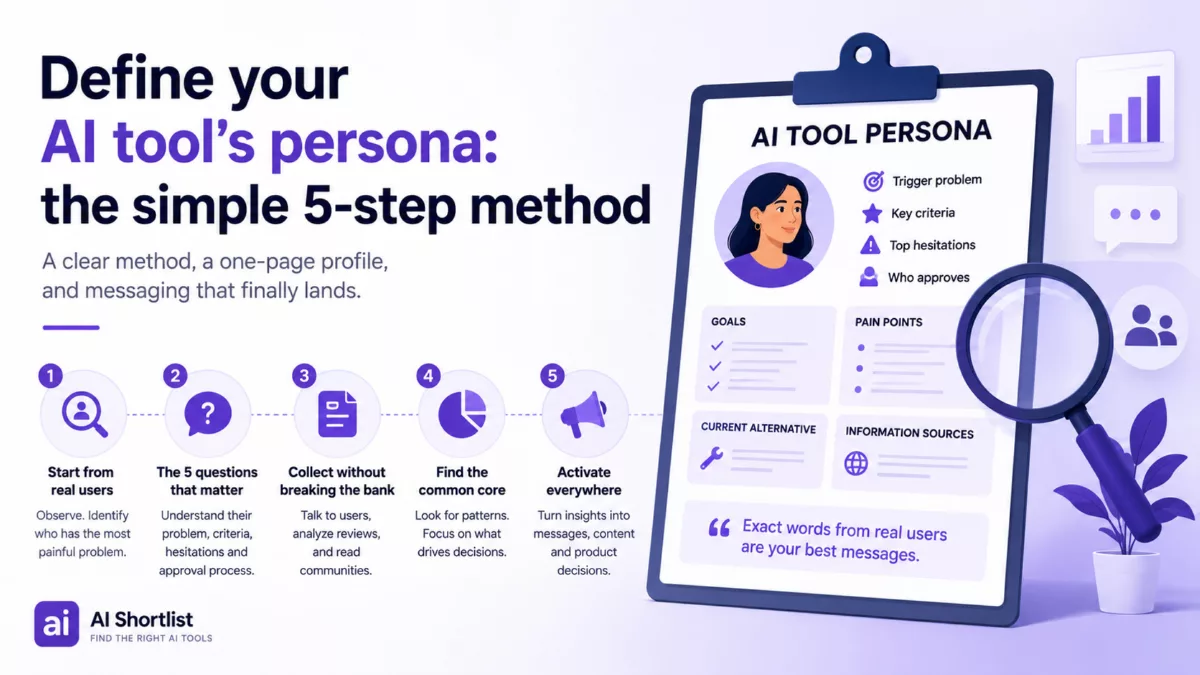
Forget twenty-item questionnaires. Five questions are enough to pin down a persona you can act on:
What problem triggers the search for a tool? Not the problem in general, the precise event: the botched meeting, the lost client, the evening spent writing up notes.
What did they do before? Handwritten notes, an intern, a spreadsheet, a competitor: the current alternative is your real opponent.
What criterion drives the choice? Output quality, price, integration with existing tools, time to get started: rarely more than one or two truly carry weight.
What makes them hesitate? Data confidentiality, fatigue at yet another subscription, doubts about AI reliability: untreated objections kill silently.
Who approves the purchase? The person themselves, their manager, a procurement chain: the answer reshapes your entire funnel.
Each answer feeds a decision: the trigger problem writes your homepage, the current alternative structures your pitch, the choice criterion ranks your features, the objections fill your FAQ, and the approval chain shapes your pricing.
Step 3: collect without breaking the bank
Good news: the best data is free. Three sources are enough, and a few days, not a few months.
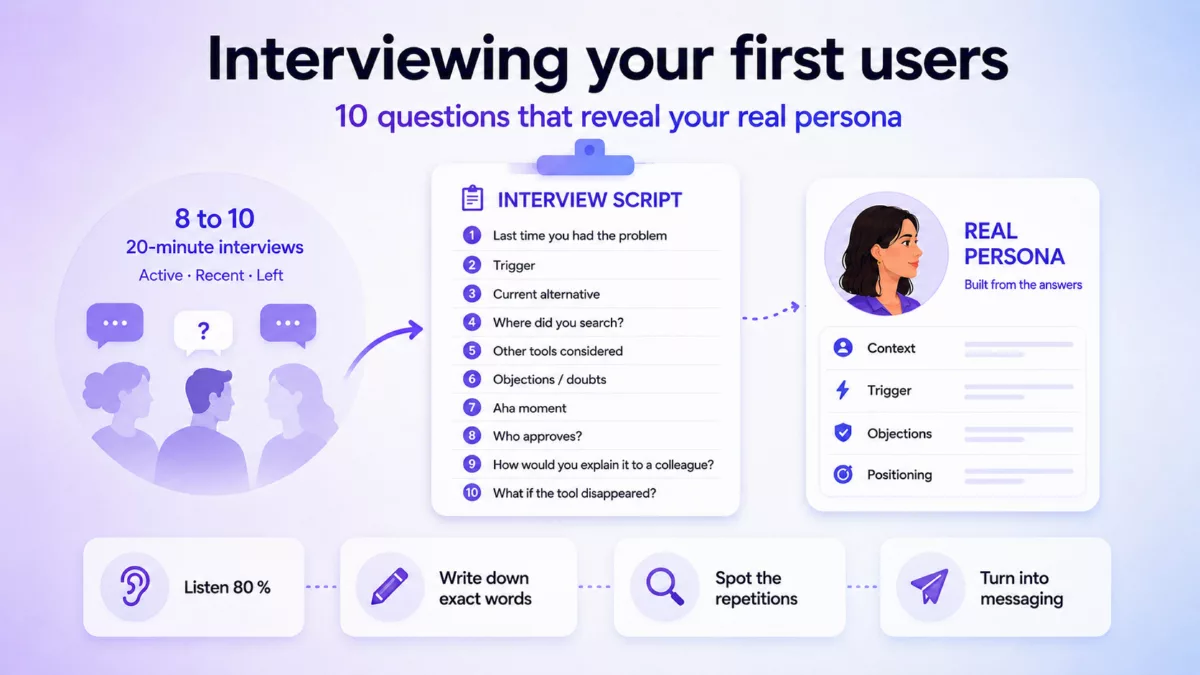
First, 8 to 10 conversations with real users, on a call or in writing. Not a survey: a conversation, where you ask the five questions from step 2 and write down the exact words people use. Those raw phrasings are gold, we'll come back to them in step 5.
Second, public reviews of competing tools. One-star and two-star reviews tell you the objections and the disappointments, five-star reviews tell you the choice criterion and the trigger problem, often in a level of detail no survey ever reaches.
Third, the recurring questions in the communities where your audience spends time. When the same question comes back every week in a Slack group or a forum, you're looking at a trigger problem phrased by the market itself.
Step 4: put it on one page
Everything fits in a seven-field table. Here is the template, filled in for a fictional AI meeting assistant:
| Field | The question to ask yourself | Filled-in example |
|---|---|---|
| Work context | Who are they, in what environment? | Project manager at an agency, 6 to 10 client meetings a week |
| Trigger problem | What precise event starts the search for a tool? | Meeting notes eat their evenings, commitments made in meetings get lost |
| Current alternative | How do they cope today? | Handwritten notes during the meeting, partial replay of recordings |
| Choice criterion | What tips the decision? | Accuracy of the meeting summary, compatibility with the existing video call tool |
| Objections | What makes them hesitate or walk away? | Confidentiality of client conversations, subscription fatigue |
| Where they discover tools | Where do they find new tools? | Professional communities, AI tool directories, peer recommendations |
| Who approves the purchase | Who pays, under what conditions? | Themselves up to $30 a month, the agency director above that |
Fill this table with the words collected in step 3, not with your assumptions. If a field stays empty, that's a signal: you're missing conversations, not imagination.
Step 5: test it in your real messaging
A persona isn't validated in a meeting, it's validated in the messaging that converts. Rewrite your homepage with the trigger problem as the headline and your users' exact words through the sections. Address objections where they arise, not on a buried page. Then watch: signup rate, questions hitting support, reactions in demos.
Your directory listing is another test bench, and an overlooked one: on a directory like AI Shortlist, your description is read by visitors actively comparing tools, the exact moment when the right message makes the difference. If your tool isn't listed yet, the Submit a tool page is the way in.
A persona is a living document: every round of conversations, every page you test sharpens it. Plan to reopen it every quarter, not to frame it on the wall.
How many personas?
One to start, two at the very most. The temptation to multiply personas is the "for everyone" trap in disguise: three vague profiles decide less well than one sharp one. Precision beats completeness, especially with a small team.
The legitimate second persona, when it exists, is rarely a second user: it's usually the decision-maker, the person who approves the purchase without using the tool. That duo deserves a guide of its own, and we wrote one: B2B personas: when your AI tool's user isn't the one holding the credit card.
Checklist: is your persona ready to work?
My profile fits on one page and every field changes a concrete decision
I've had at least 8 conversations with real users
I've read public reviews of competing tools, good and bad
My trigger problem is a precise event, not a generality
My homepage uses my users' exact words
I know who approves the purchase and above what amount
Six boxes checked: your persona is working for you. Fewer than four: go back to step 3, you're missing material, not method.