You are the worst-placed person to guess your own persona. You know your product too well: every feature feels obvious, every benefit goes without saying, and you credit your users with reasoning they never had. The good news: 8 twenty-minute conversations are enough to get surprised, and the surprises are exactly what you're after.
No UX research lab, no protocol: a user interview is a conversation, with a script. Here it is, in 10 questions you can copy as-is.
Who to interview, and how many
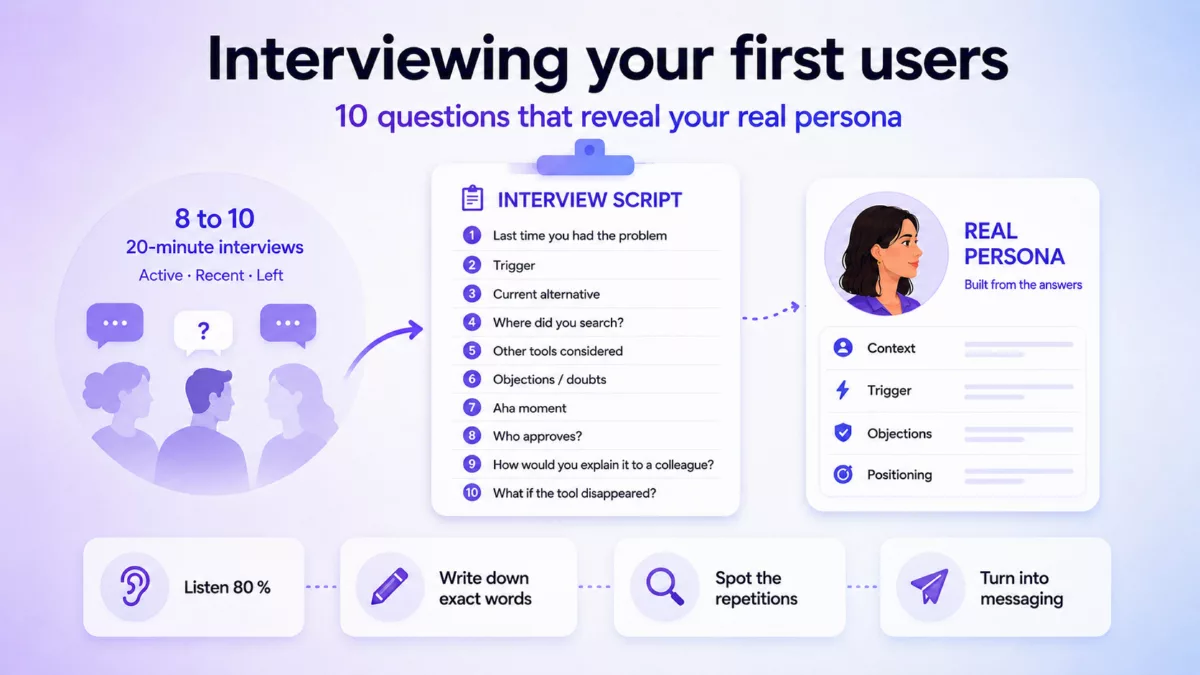
Aim for 8 to 10 people, no more: patterns start repeating by the fifth or sixth interview, and that repetition is what turns anecdotes into data. Beyond that, you're confirming, not learning.
Mix three profiles: active users who have made your tool a habit, recent users whose memory of the decision is fresh, and 1 or 2 who left. Those last ones feel intimidating to contact, and they're precious: churned users voice the objections and disappointments your loyal ones never verbalize.
Getting the interviews
The email that works is short and honest: you ask for 20 minutes, you make clear there is nothing to sell, and you explain that the person is helping shape the product. That last point is your best argument: early users of a young tool like having a say in where it goes.
A thank-you gesture is fine, a free month or a modest gift card, on one condition: it rewards the time given, never the content of the answers. A reward tied to answers produces flattering answers, which is to say false data.
The golden rules
Four rules make the difference between a useful conversation and a wasted hour.
The past, never the hypothetical. People are bad at describing what they would do and excellent at describing what they did. "Tell me about the last time..." beats "would you like..." a hundred times over. The whole script below rests on this principle.
Listen 80% of the time. If you talk more than the user, the interview has failed. Follow up with silences and "and then what?", not with your own ideas.
Never defend your product. When a user describes a friction point, the urge to explain or justify is enormous. Resist it: the interview is not a demo, and every justification closes a door.
Write down exact words, not paraphrases. Your users' raw phrasings are the treasure of the exercise: they will become your headlines, your homepage, your directory listing.
The 10 questions
Ask them in order: the script walks back through the decision, from the lived problem to the perceived value.
1. "Tell me about the last time you had [the problem], before you knew about the tool."
The opening question anchors the whole interview in lived experience. Listen for the real context: the time of day, the pressure, the people involved. That's the scene your marketing will need to tell.
2. "What made you decide to look for a solution that day?"
The problem had probably existed for months: something tipped them over the edge. That precise trigger (the botched meeting, the unhappy client, the sacrificed evening) is the best homepage headline there is.
3. "How did you handle it before?"
The real alternative is rarely a competitor: it's usually a spreadsheet, a workaround, or nothing at all. Your true opponent lives there, and your pitch should be built against it, not against the competitor you keep an eye on.
4. "Where did you search, and what did you type?"
This question delivers your channels and your keywords in one move: the communities they browsed, the AI tool directories they went through, AI Shortlist or others, the queries typed word for word. Write those queries down verbatim: that's SEO dictated by the market.
5. "What other tools did you look at, and why not them?"
You'll discover your competition as it is perceived, often very different from the one you imagine. The reasons the other tools were rejected are your differentiation arguments, phrased by the persona themselves.
6. "What almost made you give up?"
Every hesitation told here is an objection that other prospects didn't get past. Ambiguous pricing, doubts about data confidentiality, a painful signup: these frictions fill your FAQ and your reassurance pages.
7. "At what point did you think: this is worth it?"
The aha moment: the first clean meeting summary, the first usable image, the first ticket resolved without a human. Your onboarding has one single job, getting every new signup to that moment as fast as possible.
8. "Who else had a say in the decision?"
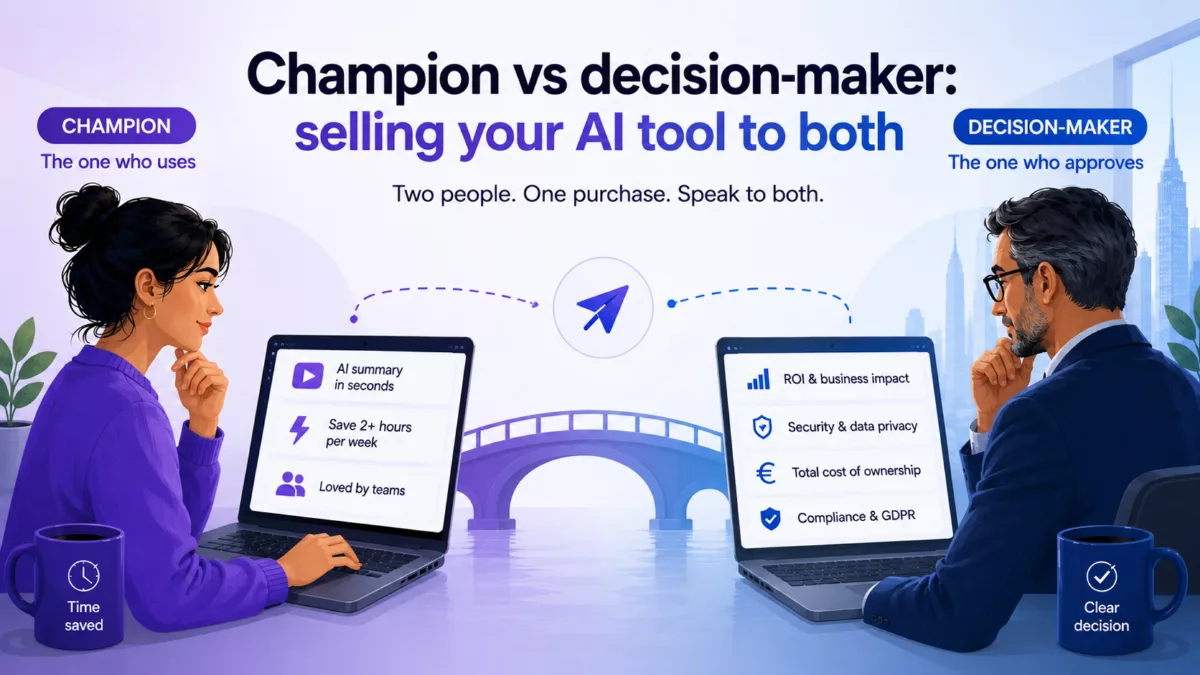
Manager, leadership, procurement, or nobody: this question maps the approval chain, and therefore your funnel. If a distinct decision-maker keeps showing up, your marketing needs to speak to them too: we wrote a full guide on that duo, B2B personas: when your AI tool's user isn't the one holding the credit card.
9. "How would you describe the tool to a colleague?"
You get your positioning sentence, written by the persona themselves, in a language their peers understand. When the same phrasing comes back across several interviews, you're holding your homepage.
10. "What would you do if the tool disappeared tomorrow?"
The only slightly hypothetical question in the script, and it's revealing: a shrug signals a replaceable tool, genuine annoyance signals real value. The words used to describe what would be lost are your value proposition.
The script in one table
The copy-and-share version, to forward to a colleague before you start:
| Question | What it reveals | What to listen for |
|---|---|---|
| 1. The last time you had the problem? | The real usage context | The scene: moment, pressure, people involved |
| 2. What made you decide that day? | The trigger | The precise event that tipped them over |
| 3. How did you handle it before? | The real alternative | The workaround: spreadsheet, manual, nothing |
| 4. Where did you search, what did you type? | Channels and keywords | The exact queries, the discovery spots |
| 5. What other tools, and why not them? | Perceived competition | The reasons the others were rejected |
| 6. What almost made you give up? | The objections | Frictions and doubts, even small ones |
| 7. When did you think it was worth it? | The aha moment | The first result that convinced them |
| 8. Who else had a say? | The approval chain | Manager, procurement, or nobody |
| 9. How would you describe it to a colleague? | The positioning | The spontaneous sentence, reusable as-is |
| 10. What if it disappeared tomorrow? | The real value | Annoyance or indifference, and the words of loss |
Assembling your real persona from the answers
This is where the 10 questions deliver on the title. After the last interview, reread all your notes in a single session and look for the repetitions: a pattern that shows up in three or more interviews is data, an isolated one is an anecdote. Keep a dozen striking verbatims, the exact sentences, awkward phrasing included.
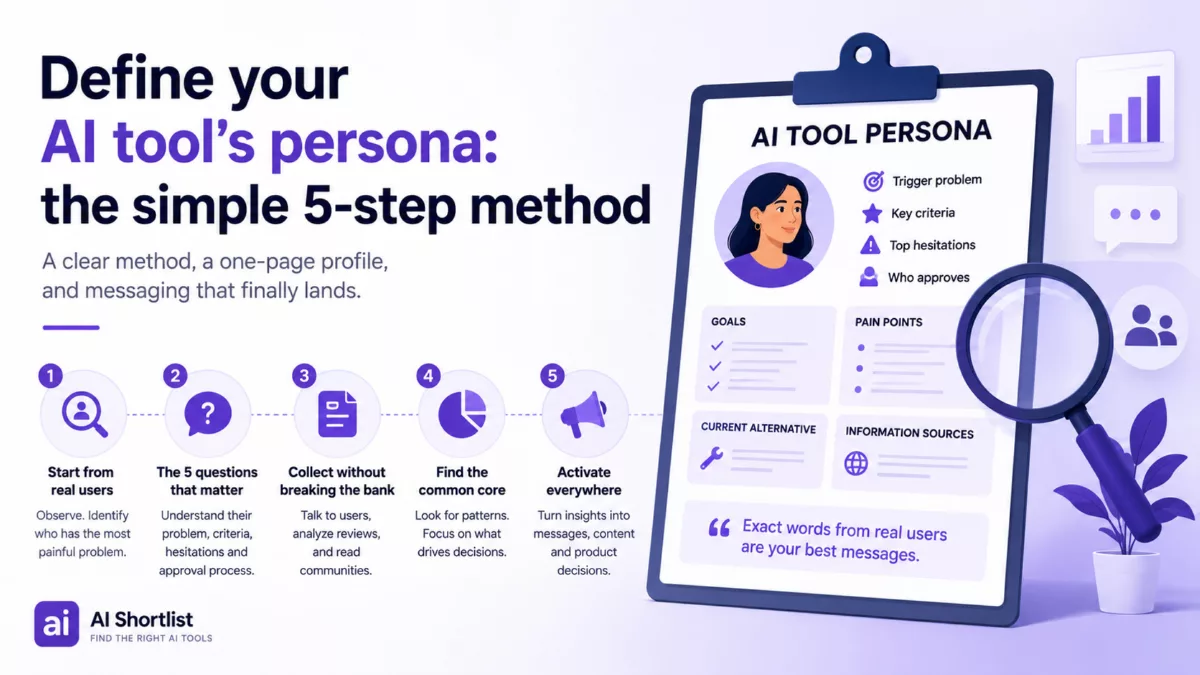
Then fill in your one-page persona profile field by field, each question having fed its own: question 1 gives the work context, question 2 the trigger problem, question 3 the current alternative, questions 5 and 7 the choice criterion, question 6 the objections, question 4 the discovery channels, question 8 the approval chain. Questions 9 and 10 throw in the positioning and the value proposition, in the market's own words. The profile template and the full method are here: Defining your AI tool's persona: the no-nonsense method.
The persona that emerges from this assembly is almost always different from the one you imagined: a more down-to-earth trigger, an alternative you weren't fighting, a discovery channel you weren't working. That's exactly why we say real persona: not the one from your assumptions, the one that eight conversations just documented. And the material keeps working beyond the profile: the queries from question 4 feed your SEO, the sentences from question 9 write your homepage and your directory listing, the objections from question 6 fill your FAQ.
Checklist before you start interviewing
I've listed 8 to 10 people: active users, recent ones, and 1 or 2 who left
My invitation email asks for 20 minutes and promises there's nothing to sell
I have the 10-question script in front of me, in order
I'm ready to listen 80% of the time and never defend the product
I can capture exact words, or I have the person's consent to record
I've blocked a full read-through session after the last interview